

pytrnsys_process.api package#
Module contents#
pytrnsys_process package for processing TRNSYS simulation results.
This package provides tools and utilities for analyzing and processing TRNSYS simulation output data.
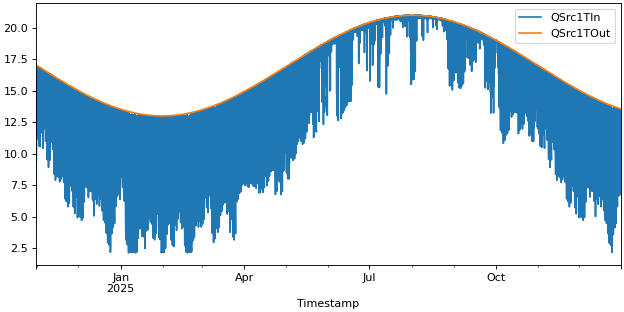
- pytrnsys_process.api.line_plot(df: DataFrame, columns: list[str], use_legend: bool = True, size: tuple[float, float] = (7.8, 3.9), **kwargs: Any) tuple[Figure, Axes][source]#
Create a line plot using the provided DataFrame columns.
- Parameters:
df (pandas.DataFrame) – the dataframe to plot
use_legend (bool, default 'True') – whether to show the legend or not
size (tuple of (float, float)) – size of the figure (width, height)
**kwargs – Additional keyword arguments are documented in
pandas.DataFrame.plot().
- Return type:
tuple of (
matplotlib.figure.Figure,matplotlib.axes.Axes)
Examples
>>> api.line_plot(simulation.hourly, ["QSrc1TIn", "QSrc1TOut"])
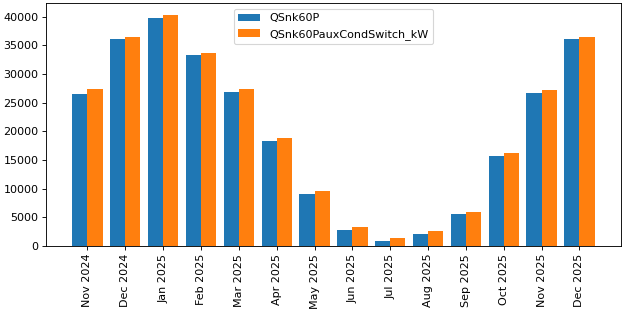
- pytrnsys_process.api.bar_chart(df: DataFrame, columns: list[str], use_legend: bool = True, size: tuple[float, float] = (7.8, 3.9), **kwargs: Any) tuple[Figure, Axes][source]#
Create a bar chart with multiple columns displayed as grouped bars. The **kwargs are currently not passed on.
- Parameters:
df (pandas.DataFrame) – the dataframe to plot
use_legend (bool, default 'True') – whether to show the legend or not
size (tuple of (float, float)) – size of the figure (width, height)
**kwargs – Additional keyword arguments to pass on to
pandas.DataFrame.plot().
- Return type:
tuple of (
matplotlib.figure.Figure,matplotlib.axes.Axes)
Examples
>>> api.bar_chart(simulation.monthly, ["QSnk60P","QSnk60PauxCondSwitch_kW"])
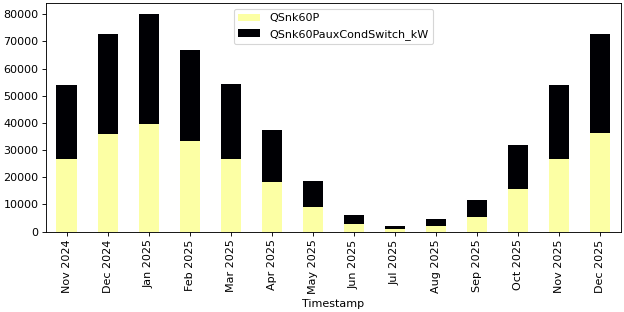
- pytrnsys_process.api.stacked_bar_chart(df: DataFrame, columns: list[str], use_legend: bool = True, size: tuple[float, float] = (7.8, 3.9), **kwargs: Any) tuple[Figure, Axes][source]#
Bar chart with stacked bars
- Parameters:
df (pandas.DataFrame) – the dataframe to plot
use_legend (bool, default 'True') – whether to show the legend or not
size (tuple of (float, float)) – size of the figure (width, height)
**kwargs – Additional keyword arguments to pass on to
pandas.DataFrame.plot().
- Return type:
tuple of (
matplotlib.figure.Figure,matplotlib.axes.Axes)
Examples
>>> api.stacked_bar_chart(simulation.monthly, ["QSnk60P","QSnk60PauxCondSwitch_kW"])
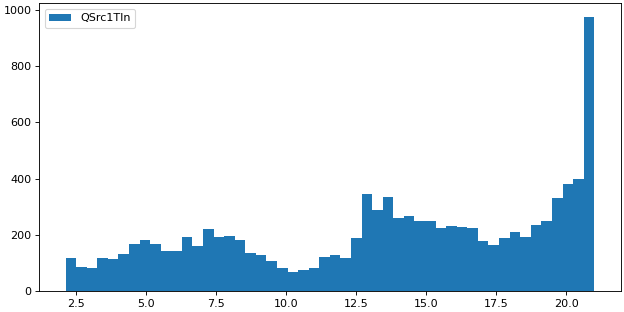
- pytrnsys_process.api.histogram(df: DataFrame, columns: list[str], use_legend: bool = True, size: tuple[float, float] = (7.8, 3.9), bins: int = 50, **kwargs: Any) tuple[Figure, Axes][source]#
Create a histogram from the given DataFrame columns.
- Parameters:
df (pandas.DataFrame) – the dataframe to plot
use_legend (bool, default 'True') – whether to show the legend or not
size (tuple of (float, float)) – size of the figure (width, height)
bins (int) – number of histogram bins to be used
**kwargs – Additional keyword arguments to pass on to
pandas.DataFrame.plot().
- Return type:
tuple of (
matplotlib.figure.Figure,matplotlib.axes.Axes)
Examples
>>> api.histogram(simulation.hourly, ["QSrc1TIn"], ylabel="")
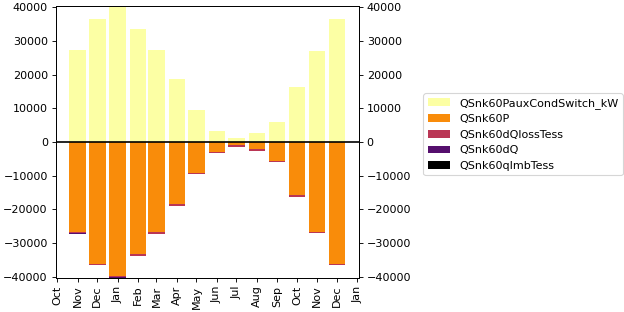
- pytrnsys_process.api.energy_balance(df: DataFrame, q_in_columns: list[str], q_out_columns: list[str], q_imb_column: str | None = None, use_legend: bool = True, size: tuple[float, float] = (7.8, 3.9), **kwargs: Any) tuple[Figure, Axes][source]#
Create a stacked bar chart showing energy balance with inputs, outputs and imbalance. This function creates an energy balance visualization where:
Input energies are shown as positive values
Output energies are shown as negative values
Energy imbalance is either provided or calculated as (sum of inputs + sum of outputs)
- Parameters:
df (pandas.DataFrame) – the dataframe to plot
q_in_columns (list of str) – column names representing energy inputs
q_out_columns (list of str) – column names representing energy outputs
q_imb_column (list of str, optional) – column name containing pre-calculated energy imbalance
use_legend (bool, default 'True') – whether to show the legend or not
size (tuple of (float, float)) – size of the figure (width, height)
**kwargs – Additional keyword arguments to pass on to
pandas.DataFrame.plot().
- Return type:
tuple of (
matplotlib.figure.Figure,matplotlib.axes.Axes)
Examples
>>> api.energy_balance(
>>> simulation.monthly,
>>> q_in_columns=["QSnk60PauxCondSwitch_kW"],
>>> q_out_columns=["QSnk60P", "QSnk60dQlossTess", "QSnk60dQ"],
>>> q_imb_column="QSnk60qImbTess",
>>> xlabel=""
>>> )
- pytrnsys_process.api.energy_balance_with_lines(df: DataFrame, q_in_columns: list[str], q_out_columns: list[str], line_columns: list[str] | None = None, q_imb_column: str | None = None, use_legend: bool = True, size: tuple[float, float] = (7.8, 3.9), **kwargs: Any) tuple[Figure, Axes, Axes][source]#
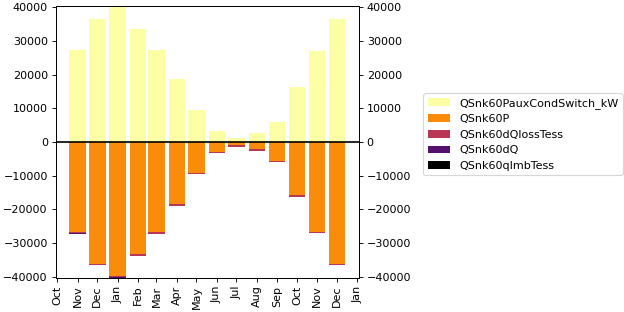
Create a stacked bar chart showing energy balance with inputs, outputs and imbalance. On top of which one or more lines will be plotted.
This function creates an energy balance visualization where:
Input energies are shown as positive values
Output energies are shown as negative values
Energy imbalance is either provided or calculated as (sum of inputs + sum of outputs)
- Parameters:
df (pandas.DataFrame) – the dataframe to plot
q_in_columns (list of str) – column names representing energy inputs
q_out_columns (list of str) – column names representing energy outputs
q_imb_column (list of str, optional) – column name containing pre-calculated energy imbalance
line_columns (list of str) – column names that should be plotted as line on top of the energy balance.
use_legend (bool, default 'True') – whether to show the legend or not
size (tuple of (float, float)) – size of the figure (width, height)
energy_balance_ylabel (str) – y-axis label for the energy balance.
line_ylabel (str) – y-axis label for the lines.
**kwargs – Additional keyword arguments to pass on to
pandas.DataFrame.plot().
- Return type:
tuple of (
matplotlib.figure.Figure,matplotlib.axes.Axes)
Examples
>>> api.energy_balance_with_lines(
>>> simulation.monthly,
>>> q_in_columns=["QSnk60PauxCondSwitch_kW"],
>>> q_out_columns=["QSnk60P", "QSnk60dQlossTess", "QSnk60dQ"],
>>> q_imb_column="QSnk60qImbTess",
>>> xlabel=""
>>> )
- pytrnsys_process.api.scatter_plot(df: DataFrame, x_column: str, y_column: str, use_legend: bool = True, size: tuple[float, float] = (7.8, 3.9), **kwargs: Any) tuple[Figure, Axes][source]#
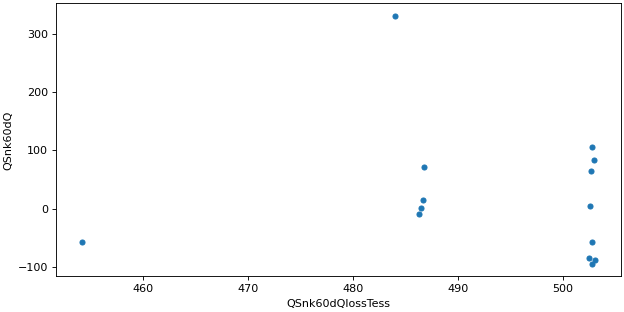
Create a scatter plot to show numerical relationships between x and y variables.
Note
Use color and not cmap!
See: https://pandas.pydata.org/pandas-docs/stable/reference/api/pandas.DataFrame.plot.scatter.html
- Parameters:
df (pandas.DataFrame) – the dataframe to plot
x_column (str) – coloumn name for x-axis values
y_column (str) – coloumn name for y-axis values
- use_legend: bool, default ‘True’
whether to show the legend or not
- size: tuple of (float, float)
size of the figure (width, height)
- **kwargs :
Additional keyword arguments to pass on to
pandas.DataFrame.plot.scatter().
- Return type:
tuple of (
matplotlib.figure.Figure,matplotlib.axes.Axes)
Examples
Simple scatter plot
>>> api.scatter_plot(
...     simulation.monthly, x_column="QSnk60dQlossTess", y_column="QSnk60dQ"
... )
- pytrnsys_process.api.scalar_compare_plot(df: DataFrame, x_column: str, y_column: str, group_by_color: str | None = None, group_by_marker: str | None = None, use_legend: bool = True, size: tuple[float, float] = (7.8, 3.9), scatter_kwargs: dict[str, Any] | None = None, line_kwargs: dict[str, Any] | None = None, **kwargs: Any) tuple[Figure, Axes][source]#
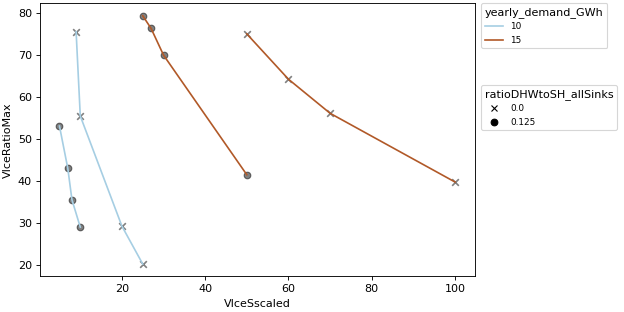
Create a scalar comparison plot with up to two grouping variables. This visualization allows simultaneous analysis of:
Numerical relationships between x and y variables
Categorical grouping through color encoding
Secondary categorical grouping through marker styles
Note
To change the figure properties a separation is included. scatter_kwargs are used to change the markers. line_kwargs are used to change the lines.
See: - markers: https://matplotlib.org/stable/api/_as_gen/matplotlib.axes.Axes.scatter.html - lines: https://matplotlib.org/stable/api/_as_gen/matplotlib.axes.Axes.plot.html
- Parameters:
df (pandas.DataFrame) – the dataframe to plot
x_column (str) – column name for x-axis values
y_column (str) – column name for y-axis values
group_by_color (str, optional) – column name for color grouping
group_by_marker (str, optional) – column name for marker style grouping
use_legend (bool, default 'True') – whether to show the legend or not
size (tuple of (float, float)) – size of the figure (width, height)
line_kwargs – Additional keyword arguments to pass on to
matplotlib.axes.Axes.plot().scatter_kwargs – Additional keyword arguments to pass on to
matplotlib.axes.Axes.scatter().**kwargs – Should never be used! Use ‘line_kwargs’ or ‘scatter_kwargs’ instead.
- Return type:
tuple of (
matplotlib.figure.Figure,matplotlib.axes.Axes)
Examples
Compare plot
>>> api.scalar_compare_plot(
...     comparison_data,
...     x_column="VIceSscaled",
...     y_column="VIceRatioMax",
...     group_by_color="yearly_demand_GWh",
...     group_by_marker="ratioDHWtoSH_allSinks",
... )
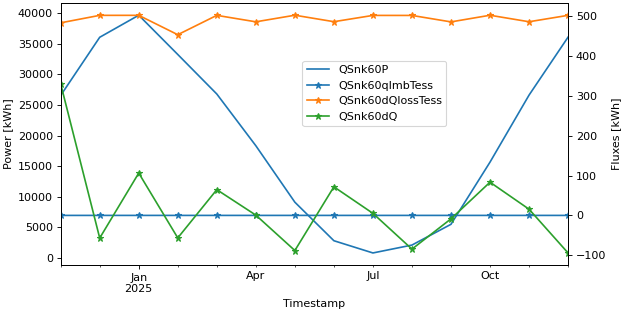
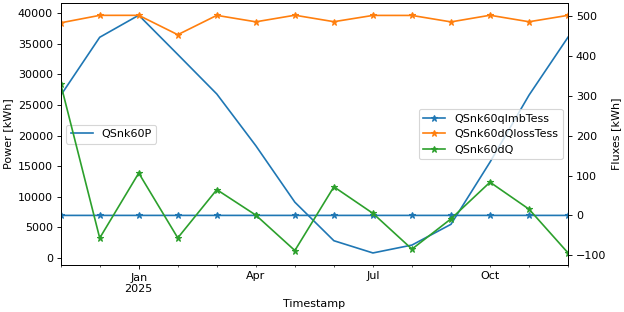
- pytrnsys_process.api.get_figure_with_twin_x_axis() tuple[Figure, Axes, Axes][source]#
Used to make figures with different y axes on the left and right. To create such a figure, pass the lax to one plotting method and pass the rax to another.
Warning
Be careful when combining plots. MatPlotLib will not complain when you provide incompatible x-axes. An example: combining a time-series with dates with a histogram with temperatures. In this case, the histogram will disappear without any feedback.
Note
The legend of a twin_x plot is a special case: To have all entries into a single plot, use fig.legend https://matplotlib.org/stable/api/_as_gen/matplotlib.figure.Figure.legend.html
To instead have two separate legends, one for each y-axis, use lax.legend and rax.legend. https://matplotlib.org/stable/api/_as_gen/matplotlib.axes.Axes.legend.html
- Returns:
fig – Figure object
lax – Axis object for the data on the left y-axis.
rax – Axis object for the data on the right y-axis.
Examples
Twin axis plot with a single legend
>>> fig, lax, rax = api.get_figure_with_twin_x_axis()
>>> api.line_plot(simulation.monthly, ["QSnk60P",], ylabel="Power [kWh]", use_legend=False, fig=fig, ax=lax)
>>> api.line_plot(simulation.monthly, ["QSnk60qImbTess", "QSnk60dQlossTess", "QSnk60dQ"], marker="*",
...     ylabel="Fluxes [kWh]", use_legend=False, fig=fig, ax=rax)
>>> fig.legend(loc="center", bbox_to_anchor=(0.6, 0.7))
Twin axis plot with two legends
>>> fig, lax, rax = api.get_figure_with_twin_x_axis()
>>> api.line_plot(simulation.monthly, ["QSnk60P",], ylabel="Power [kWh]", use_legend=False, fig=fig, ax=lax)
>>> api.line_plot(simulation.monthly, ["QSnk60qImbTess", "QSnk60dQlossTess", "QSnk60dQ"], marker="*",
...     ylabel="Fluxes [kWh]", use_legend=False, fig=fig, ax=rax)
>>> lax.legend(loc="center left")
>>> rax.legend(loc="center right")
- pytrnsys_process.api.process_whole_result_set_parallel(results_folder: Path, processing_scenario: Callable[[Simulation], None] | Sequence[Callable[[Simulation], None]], max_workers: int | None = None) SimulationsData[source]#
Process all simulation folders in a results directory in parallel.
Uses a ProcessPoolExecutor to process multiple simulations concurrently, applying the provided processing step/scenario to each simulation.
Using the default settings your structure should look like this:
results_folder├─ sim-1├─ sim-2├─ sim-3├─ temp├─ your-printer-files.prt- Parameters:
pathlib.Path (results_folder) – Path to the directory containing simulation folders. Each subfolder should contain a temp folder containing valid simulation data files.
processing_scenario (collections.abc.Callable or collections.abc.Sequence of collections.abc.Callable) – They should containd the processing logic for a simulation. Each callable should take a Simulation object as its only parameter and modify it in place.
int (max_workers) – Maximum number of worker processes to use. If None, defaults to the number of processors on the machine.
None (default) – Maximum number of worker processes to use. If None, defaults to the number of processors on the machine.
- Returns:
SimulationsData –
monthly: Dict mapping simulation names to monthly DataFrame results
hourly: Dict mapping simulation names to hourly DataFrame results
scalar: DataFrame containing scalar/deck values from all simulations
- Return type:
- Raises:
ValueError – If results_folder doesn’t exist or is not a directory:
Exception – Individual simulation failures are logged but not re-raised:
Example
>>> import pathlib as _pl
>>> from pytrnsys_process import api
...
>>> def processing_step_1(sim):
...     # Process simulation data
...     pass
>>> def processing_step_2(sim):
...     # Process simulation data
...     pass
>>> results = api.process_whole_result_set_parallel(
...     _pl.Path("path/to/results"),
...     [processing_step_1, processing_step_2]
... )
- pytrnsys_process.api.process_single_simulation(sim_folder: Path, processing_scenario: Callable[[Simulation], None] | Sequence[Callable[[Simulation], None]]) Simulation[source]#
Process a single simulation folder using the provided processing step/scenario.
- Parameters:
sim_folder (pathlib.Path) – Path to the simulation folder to process
processing_scenario (collections.abc.Callable or collections.abc.Sequence of collections.abc.Callable) – They should contain the processing logic for a simulation. Each callable should take a Simulation object as its only parameter and modify it in place.
- Returns:
Simulation
- Return type:
Example
>>> import pathlib as _pl
>>> from pytrnsys_process import api
...
>>> def processing_step_1(sim: api.Simulation):
...     # Process simulation data
...     pass
>>> results = api.process_single_simulation(
...     _pl.Path("path/to/simulation"),
...     processing_step_1
... )
- pytrnsys_process.api.process_whole_result_set(results_folder: Path, processing_scenario: Callable[[Simulation], None] | Sequence[Callable[[Simulation], None]]) SimulationsData[source]#
Process all simulation folders in a results directory sequentially.
Processes each simulation folder found in the results directory one at a time, applying the provided processing step/scenario to each simulation.
Using the default settings your structure should look like this:
results_folder├─ sim-1├─ sim-2├─ sim-3├─ temp├─ your-printer-files.prt- Parameters:
pathlib.Path (results_folder) – Path to the directory containing simulation folders. Each subfolder should contain a temp folder containing valid simulation data files.
processing_scenario (collections.abc.Callable or collections.abc.Sequence of collections.abc.Callable) – They should containd the processing logic for a simulation. Each callable should take a Simulation object as its only parameter and modify it in place.
- Returns:
SimulationsData –
monthly: Dict mapping simulation names to monthly DataFrame results
hourly: Dict mapping simulation names to hourly DataFrame results
scalar: DataFrame containing scalar/deck values from all simulations
- Return type:
- Raises:
ValueError – If results_folder doesn’t exist or is not a directory:
Exception – Individual simulation failures are logged but not re-raised:
Example
>>> import pathlib as _pl
>>> from pytrnsys_process import api
...
>>> def processing_step_1(sim):
...     # Process simulation data
...     pass
>>> def processing_step_2(sim):
...     # Process simulation data
...     pass
>>> results = api.process_whole_result_set(
...     _pl.Path("path/to/results"),
...     [processing_step_1, processing_step_2]
... )
- pytrnsys_process.api.do_comparison(comparison_scenario: Callable[[SimulationsData], None] | Sequence[Callable[[SimulationsData], None]], simulations_data: SimulationsData | None = None, results_folder: Path | None = None) SimulationsData[source]#
Execute comparison scenarios on processed simulation results.
- Parameters:
comparison_scenario (collections.abc.Callable or collections.abc.Sequence of collections.abc.Callable) – They should containd the comparison logic. Each callable should take a SimulationsData object as its only parameter and modify it in place.
simulations_data (SimulationsData, optional) – SimulationsData object containing the processed simulations data to be compared.
results_folder (pathlib.Path, optional) – Path to the directory containing simulation results. Used if simulations_data is not provided.
- Returns:
SimulationsData
- Return type:
Example
>>> from pytrnsys_process import api
...
>>> def comparison_step(simulations_data: ds.SimulationsData):
...     # Compare simulation results
...     pass
...
>>> api.do_comparison(comparison_step, simulations_data=processed_results)
- pytrnsys_process.api.export_plots_in_configured_formats(fig: Figure, path_to_directory: str, plot_name: str, plots_folder_name: str = 'plots') None[source]#
Save a matplotlib figure in multiple formats and sizes.
Saves the figure in all configured formats (png, pdf, emf) and sizes (A4, A4_HALF) as specified in the plot settings (api.settings.plot). For EMF format, the figure is first saved as SVG and then converted using Inkscape.
- Parameters:
fig – The matplotlib Figure object to save.
path_to_directory – Directory path where the plots should be saved.
plot_name – Base name for the plot file (will be appended with size and format).
plots_folder_name – leave empty if you don’t want to save in a new folder
Note
Creates a ‘plots’ subdirectory if it doesn’t exist
For EMF files, requires Inkscape to be installed at the configured path
File naming format: {plot_name}-{size_name}.{format}
Example
>>> from pytrnsys_process import api, data_structures
>>> def processing_of_monthly_data(simulation: data_structures.Simulation):
>>>     monthly_df = simulation.monthly
>>>     columns_to_plot = ["QSnk60P", "QSnk60PauxCondSwitch_kW"]
>>>     fig, ax = api.bar_chart(monthly_df, columns_to_plot)
>>>
>>>     # Save the plot in multiple formats
>>>     api.export_plots_in_configured_formats(fig, simulation.path, "monthly-bar-chart")
>>>     # Creates files like:
>>>     #   results/simulation1/plots/monthly-bar-chart-A4.png
>>>     #   results/simulation1/plots/monthly-bar-chart-A4.pdf
>>>     #   results/simulation1/plots/monthly-bar-chart-A4.emf
>>>     #   results/simulation1/plots/monthly-bar-chart-A4_HALF.png
>>>     #   etc.
- class pytrnsys_process.api.Defaults(*values)[source]#
Bases:
EnumDefault settings for different use cases
- DEFAULT = Settings(plot=Plot(file_formats=['.png', '.pdf', '.emf'], figure_sizes={'A4': (7.8, 3.9), 'A4_HALF': (3.8, 3.9)}, inkscape_path='C://Program Files//Inkscape//bin//inkscape.exe', date_format='%b %Y', label_font_size=10, legend_font_size=8, title_font_size=12, markers=['x', 'o', '^', 'D', 'v', '<', '>', 'p', '*', 's']), reader=Reader(folder_name_for_printer_files='temp', read_step_files=False, read_deck_files=True, force_reread_prt=False, starting_year=2024))#
- class pytrnsys_process.api.Simulation(path: str, monthly: DataFrame, hourly: DataFrame, step: DataFrame, scalar: DataFrame)[source]#
Bases:
objectClass representing a TRNSYS simulation with its associated data.
This class holds the simulation data organized in different time resolutions (monthly, hourly, timestep) along with the path to the simulation files.
- monthly#
Monthly aggregated simulation data. Each column represents a different variable and each row represents a month.
- Type:
- hourly#
Hourly simulation data. Each column represents a different variable and each row represents an hour.
- Type:
- step#
Simulation data at the smallest timestep resolution. Each column represents a different variable and each row represents a timestep.
- Type:
- __init__(path: str, monthly: DataFrame, hourly: DataFrame, step: DataFrame, scalar: DataFrame) None#
- monthly: DataFrame#
- hourly: DataFrame#
- step: DataFrame#
- scalar: DataFrame#
- class pytrnsys_process.api.SimulationsData(simulations: dict[str, ~pytrnsys_process.process.data_structures.Simulation] = <factory>, scalar: ~pandas.core.frame.DataFrame = <factory>, path_to_simulations: str = <factory>)[source]#
Bases:
objectClass representing a result set
Used to do comparisons plots across different simulations
- simulations#
Can be accessed using the simulations names as keys. Example:
simulations['sim_001']- Type:
dict of {str, Simulation}
- scalar#
Contains all deck constant deck values from all simulations. This is also the place to store your calculations for plotting.
- Type:
- __init__(simulations: dict[str, ~pytrnsys_process.process.data_structures.Simulation] = <factory>, scalar: ~pandas.core.frame.DataFrame = <factory>, path_to_simulations: str = <factory>) None#
- simulations: dict[str, Simulation]#
- scalar: DataFrame#
- pytrnsys_process.api.load_simulations_data_from_pickle(path: ~pathlib.Path, logger: ~logging.Logger = <Logger default_pytrnsys_process (WARNING)>) SimulationsData[source]#
Load SimulationsData from a pickle file.
This function loads a previously saved SimulationsData object from a pickle file.
- Parameters:
path (pathlib.Path) – To the pickle file to load
logger (logging.Logger, optional) – Logger object that will log any messages, warnings, and/or errors
- Returns:
SimulationsData – Reconstructed SimulationsData object
- Return type:
pytrnsys_processing.data_structures.SimulationsData- Raises:
OSError – If there’s an error reading the file:
pickle.UnpicklingError – If the file is corrupted or invalid:
- pytrnsys_process.api.load_simulation_from_pickle(path: ~pathlib.Path, logger: ~logging.Logger = <Logger default_pytrnsys_process (WARNING)>) Simulation[source]#
Load a Simulation object from a pickle file.
This function loads a previously saved Simulation object from a pickle file.
- Parameters:
path (pathlib.Path) – To the pickle file to load
logger (logging.Logger, optional) – Logger object that will log any messages, warnings, and/or errors
- Returns:
Simulation – Reconstructed Simulation object
- Return type:
pytrnsys_processing.data_structures.Simulation- Raises:
OSError – If there’s an error reading the file:
pickle.UnpicklingError – If the file is corrupted or invalid:
- pytrnsys_process.api.get_date_time_axis_locator_and_formatter(data_frequency: Literal['step', 'hourly', 'monthly']) Tuple[AutoDateLocator, ConciseDateFormatter][source]#
Method to prepare an axis locator and a date time formattter to adjust the date time formatting. Can be used as follows: ax.xaxis.set_major_formatter(formatter) ax.xaxis.set_major_locator(date_locator)
- Parameters:
data_frequency (str) – Size of the timestep. This can be ‘step’, ‘hourly’, and ‘monthly’.
- pytrnsys_process.api.get_frequency_of_data(df: DataFrame) Literal['step', 'hourly', 'monthly'][source]#
Method to identify the timestep size of the give dataframe. Can return ‘step’, ‘hourly’, and ‘monthly’.
- pytrnsys_process.api.format_date_time_twin_axis(lax: Axes, rax: Axes, data_frequency: Literal['step', 'hourly', 'monthly'])[source]#
Method to update dateTime formatting for twin axes.
- Parameters:
lax (_plt.Axes) – left-axis handle
rax (_plt.Axes) – right-axis handle
data_frequency (str) – Size of the timestep. This can be ‘step’, ‘hourly’, and ‘monthly’.